On Saturday, 06 January the Malagentian Cook’s Guild held a 12th Night Garbed Pot Luck in collaboration with the Forest Court of Malagentia (More Information on both guilds can be found at the bottom of the post)
Never one to let a opportunity slip by to either 1) dress up and 2) crack open one of my books on medieval food, I of course had to go! (It also helped that the event was less than 15 minutes from my house, so easy to get to, and easy to get home from with a winter storm on the horizon.
I had originally been planning to make a salt cod dish, as would have been something that would have been seen on the table of Tudor period folks during this time, though not necessarily during the 12th Night period. But, salt cod being thin on the ground in my part of Maine, I went with plan 2, Chicken with Fennel.
This recipe originally appears in Frammento di un libro di cucina del sec. XIV, edited by Olindo Guerrini. I am using the translation from The Medieval Kitchen- Recipes from France and Italy by Odile Redon, Francoise Sabban and Silvano Servennti, Translated by Edward Schneider.
Fennel Chicken
Take then chickens, cut them up, fry them, and when they are fried add the quantity of water you prefer; then take “beards” of fennel, “beards” of parsley, and almonds that have not been skinned; and chop these well, mix them with the liquid from the chicken, and boil everything, then pass through a sieve. Add it to the chicken, and add the best spices you can get – Guierrini 45
Redacted Recipe:
- 1 Free Range Chicken *
- 2/3 cup (100g) unblanched almonds
- a handful of dill or fennel leaves
- a handfull of parsley
- 2 cups (1/2 litter) water
- scant 1/2 teaspoon fine spices **
- 2 tablespoons lard or oil
- salt
Cut the chicken into serving pieces and pat dry. Melt the lard/heat the oil in a casserole over medium high heat and brown the chicken. When it is golden brown, add the water and salt to taste. Lower the heat and summer, covered, for 40-45 minutes or until tender.
Meanwhile, wash and thoroughly dry the herbs. Grind the almonds finely in a blender, then add the herbs and blend to a paste.
Remove the chicken from the casserole and keep it warm in a very low oven (~170F) covered loosely with aluminium foil.
Add the almond mixture to the casserole and recude over medium heat until the sauce has thickened.
Arrange the chicken on a serving platter and strain the sauce over the chicken. Sprinkle with the spices to taste and serve.
Fine Spice Mixture
Fine Spices for all foods. Take an onza of pepper and one of cinnamon and one of ginger and half a quarter of cloves and a quarter of Saffron (Libro di cucino del secolo XI, Ludovico Frati, editor)
- 2 rounded tablespoons ( 16 g) freshly ground black pepper
- 2 rounded tablespoons (16g) ground cinnamon
- 2 rounded tablespoons (16 g) ground ginger
- 1.5 tablespoonds (4 g) saffron threads, crushed to powder in a mortar or with your fingers
- 3/4 teaspoon (2 g) ground cloves
Add photos of each step
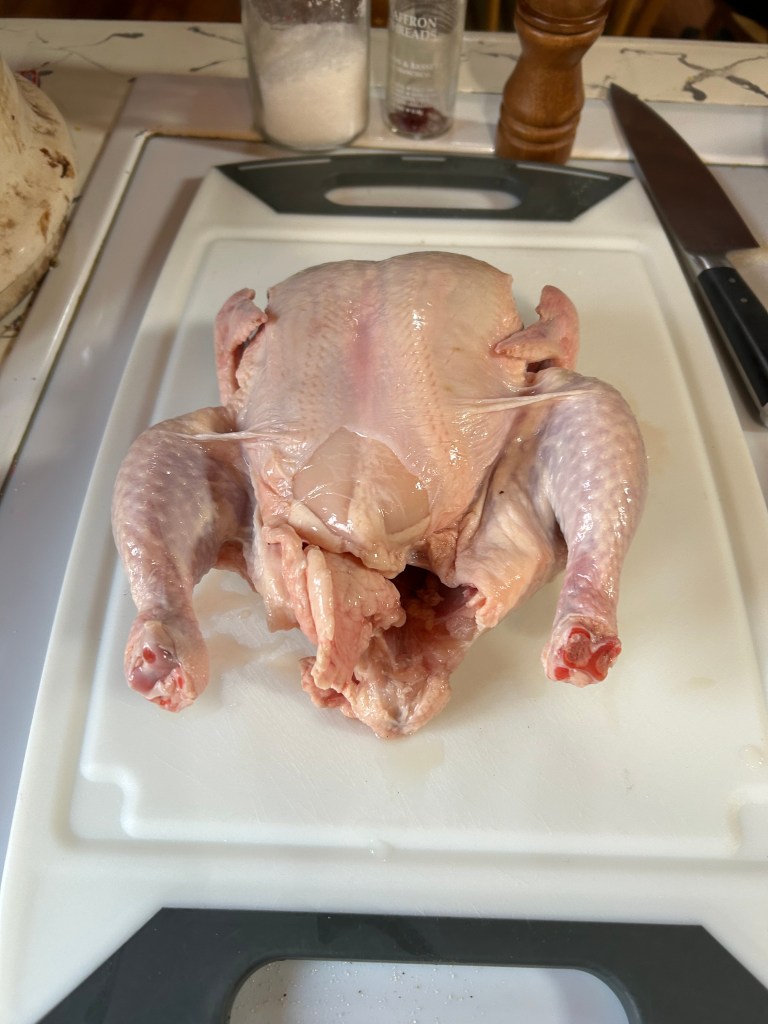
First Step, cut up your whole chicken. I was able to divide the breasts in half, given their size

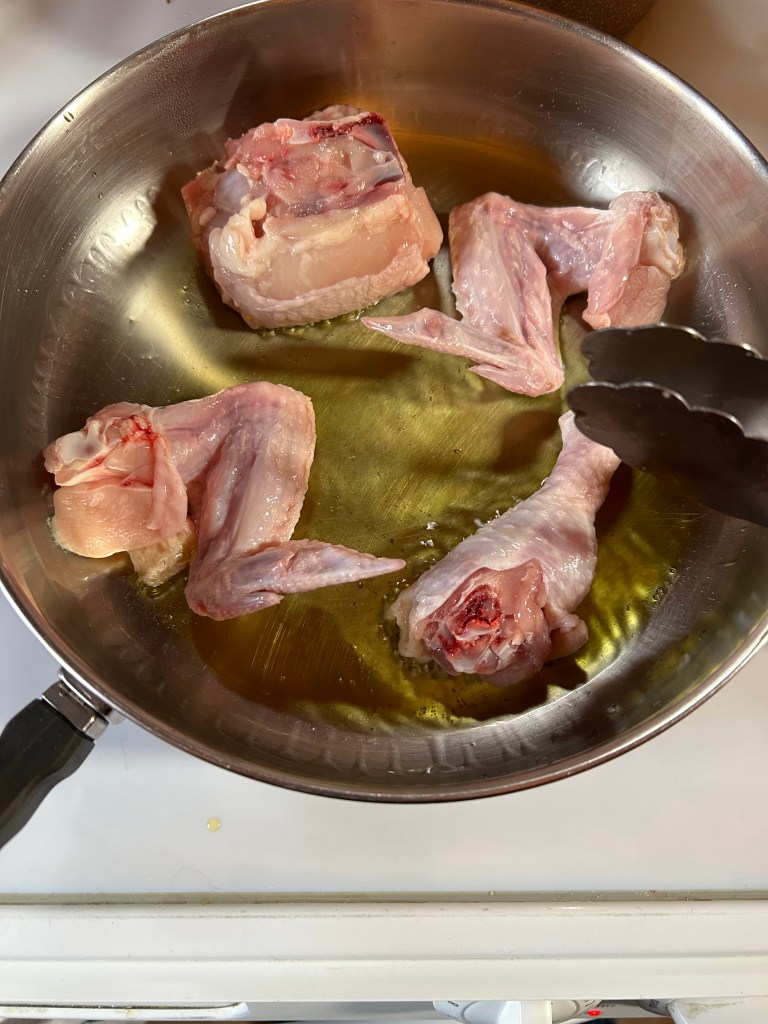
As I do not have an enamel dutch oven yet (it’s on the to do list) I fried mine in my trusty 1970’s pan, making sure not to crowd it.
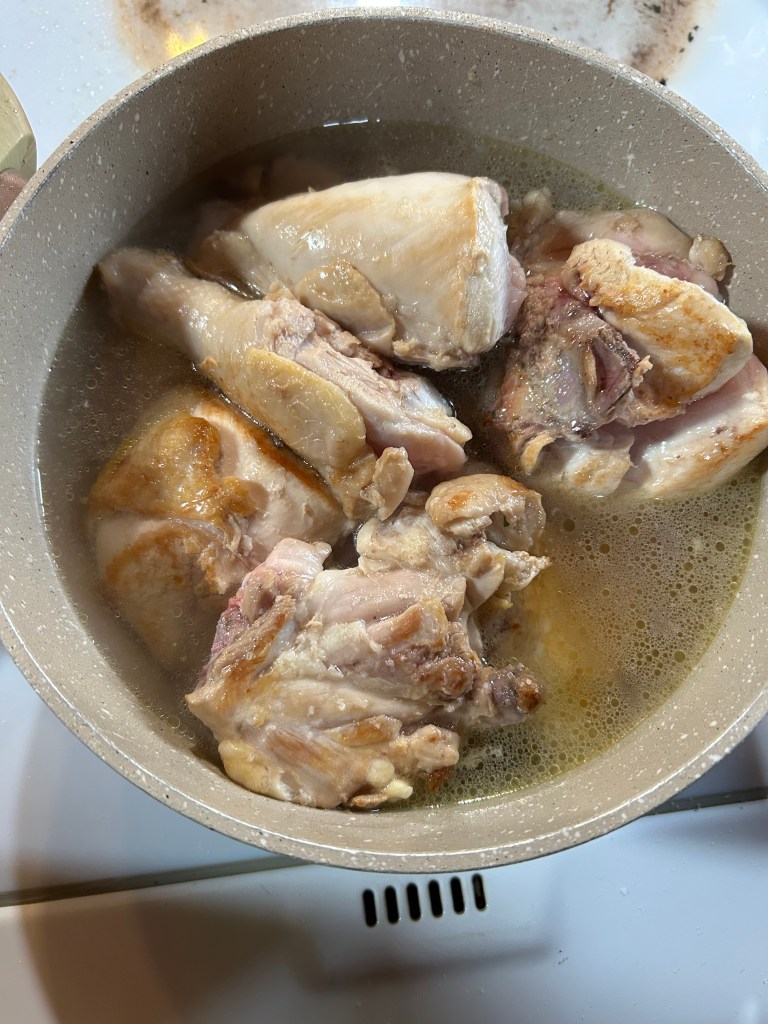
And then transferred it to a pot to simmer.
Then measured out the almonds, dill and parsley to give them a blitz.
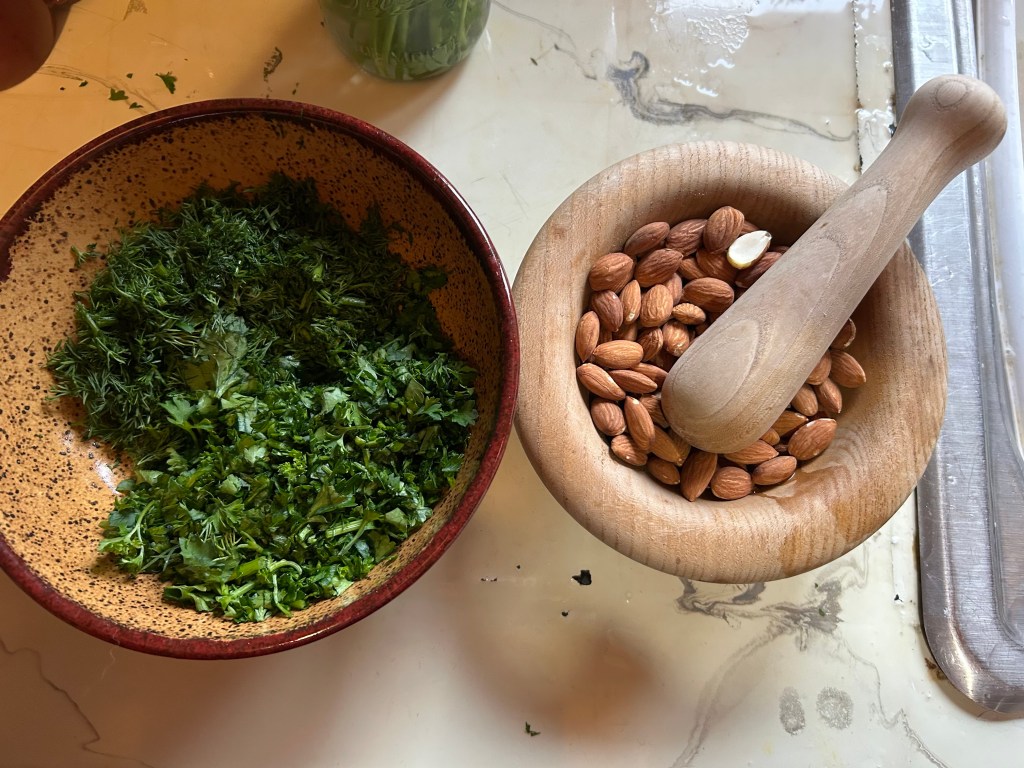
I do not have a blender currently; getting a Vitamix has been on the list for a number of years now, but as a new homeowner, I have had other priorities that I’ve been taking care of first (like a generator, cause Maine. And taking my pets to the vet for dental surgery). And, they did not have blenders in the Medieval period. What they did have were a number of large and heavy mortar and pestles, as well as knives and cutting boards. I, however, chose to use my immersion blender and a bowl. I ended up having to add water in order to make it blend, and I think the next time I would use a food processor instead.
The final product:
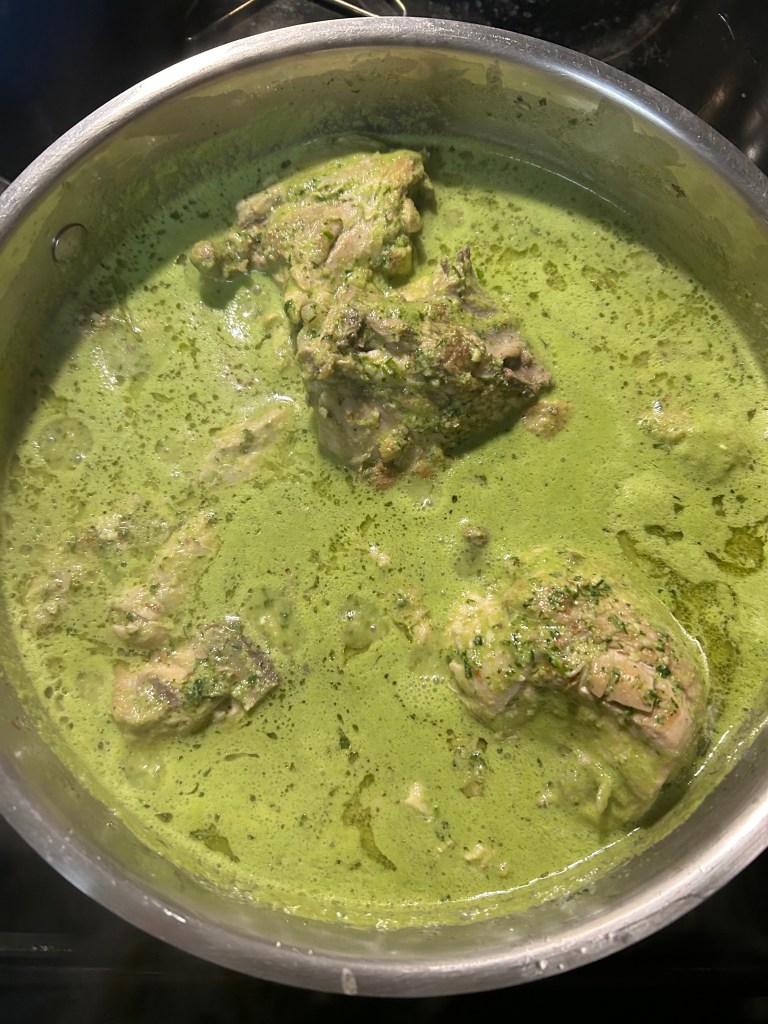
It is a lovely shade of green. A couple of things I would do differently next time:
- Now that I’ve made it, I’d swap out pine nuts, walnuts or pistachios for the almonds. The pine nuts might be prohibitively expensive due to the quantity needed
- I think a smoother sauce could be created by removing the chicken from the pot, adding the puree to that, letting that simmer and then giving it another wiz with the immersion blender.
I would totally make this again; it was tasty and I have left overs in the fridge for at least two more meals this week.
A word on meat- most chefs/cooks will tell you to buy the best meat, in this case chicken, that you can afford. I’d like you to keep a couple of things in mind when working on a period recipe
- Modern chickens that are found in grocery stores, unless you are purchasing a free range chicken, are much larger and much more tender than period chickens. If you are lucky enough to either have your own hertigage breed chickens or know someone who does, they are typically going to be smaller and tougher. Chickens that get lots of outdoor time and exercise are more well muscled, but also tend to be chewier and more flavorful
- With the exception of the rich, and even then I’m not 100% sure and need to do more research, animals that produced things like wool, milk, and eggs were kept alive until they were no longer productive and were then slaughtered for their meat.( Pigs being the exception to this rule). A farmer making a dish like this around 12th night or any of the other celebratory days would have been using an old egg laying hen, and those things are not tender at all, and require additional stewing time.
Additional information:
Province of Malagentia. :https://malagentia.eastkingdom.org/main/
Forest Court of Malagentia: https://malagentia.eastkingdom.org/main/foresters-guild/
Malagentian Cook’s Guild : https://malagentia.eastkingdom.org/main/cooking/
(Please note that both the Forest Court and Cook’s Guild pages will be under construction shortly)
Heritage Animal Breeds: https://livestockconservancy.org/heritage-breeds/
Project’s Spotify Playlist https://open.spotify.com/playlist/37i9dQZF1E38dccXtuZv1N?si=6d3d36249aea46d9
Source Book: The Medieval Kitchen- Recipes from France and Italy by Odile Redon, Francoise Sabban and Silvano Serventi. Translated by Edward Schneider. Published by The University of Chicago Press, 1998
 Meara's Making Mischief