So, it’s been a minute since there’s been a new blog post, and a lot has happened in that time. I sold my house and moved back to Mass, which I said I’d never do again, and yet here we are. I had major surgery that I am 100% — okay, maybe more like 95% — recovered from, and with that, all systems are go. I repeat: all systems are a go.
So what does that mean? It means it’s time to deep dive back into research. It’s time to start crafting and creating and making things, to reconnect with the crafts that I love, and to learn new skills. With this also comes a change in theme, a clarification of paths, and an update on all things SCA, so let’s dive in.
When I started with the SCA, I started with an early-period Hiberno-Norse persona. For a newish sewer, triangles, squares, and rectangles are easy, even if a keyhole neckline is an absolute bugger. I made a few preliminary outfits based on some fast-and-loose internet searches and leaned heavily into what I affectionately call “close enough for Norse-ish.” There is 100% nothing wrong with that. It worked for me back then, and I encourage people to use that approach if it works for them now. After that, I dabbled in some later-period garb and persona ideas, then wound up back in the 10th-century Hiberno-Norse zone for a number of reasons.
Information on late Iron Age and early medieval Irish clothing is pretty thin on the ground. Part of the problem is preservation. Irish bogs are very acidic, and while those acidic, anaerobic conditions can preserve some organic materials remarkably well, preservation is uneven. Animal-based materials such as skin, hair, and wool may survive in ways that plant-based textiles like linen often do not, which complicates any attempt to reconstruct a full clothing system from surviving finds.
Mortuary evidence is also tricky. Cremation continued in parts of first-millennium Ireland alongside inhumation, which means clothing evidence from graves is not as straightforward or abundant as it is in some other regions.
There also appears to have been a population decline during the Iron Age and early medieval period in Ireland, for reasons that are still not well understood. Archaeologists are continuing to study this question, but it adds another layer of complication when looking at settlement patterns, material culture, and the survival of evidence.
There is some information in early Irish legal material about clothing, color, value, and status. Fergus Kelly’s Early Irish Farming discusses the price and importance of sheep fleeces in early Ireland, including distinctions between fleece colors. From that, we can cautiously think about wool, wool cloth, dyeing, and textile value. White fleeces, for example, may have been more valuable than tan or black fleeces in part because they were easier to dye. (Kelly, Early Irish Farming, 67–77)
Both flax and linen are also mentioned in Cáin Lánamna, indicating that linen was known and used in early medieval Ireland, though that still does not tell us exactly how garments were cut or constructed. (Kelly, Early Irish Farming, 269)
So while we know that wool and linen were part of the clothing world, and while literary evidence gives us some idea of garment categories — brats or mantles as outer layers, and léinte as inner or underlayers — what we are often missing is the practical construction evidence. What did these garments look like? How were they shaped? How were they sewn? How much did they vary by region, status, gender, and period?
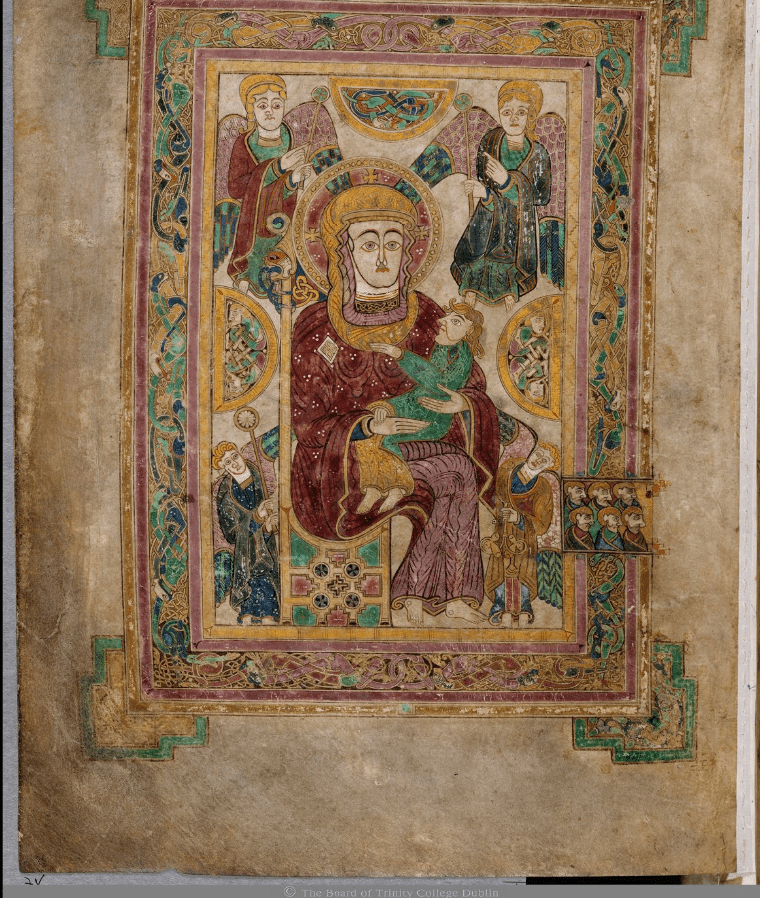
(Image from Book of Kells. Folio 7v: Virgin and Child)
Another issue is that this is just about the only female figure we have from this period for Ireland that is not a carving. The fastening shown at the chest has often reminded modern viewers of early medieval Irish brooch forms, and I’d like to compare it more carefully with National Museum of Ireland examples once I can access the relevant object records. At the time of writing, the National Museum of Ireland website is having technical difficulties, so that image is currently unavailable.
The red outer layer appears to be a brat, though it is missing the fringe usually associated with the garment. That could be an artistic choice, or they could be like me: fringe gives me a textural ick.
So why Hiberno-Norse? Why come back to this particular time, place, and cultural tangle?
Part of it is practical. I already had one foot in this world when I started in the SCA, even if that first version was held together with enthusiasm, rectangles, and vibes. But the more I come back to it, the more I realize that 10th-century Hiberno-Norse Dublin sits right at the intersection of so many things I care about: textiles, trade, identity, migration, craft, adaptation, and the messy reality of people living in contact with one another.
And part of it is personal.
This is where my family is from. This is where my history starts, or at least one of the places where it starts. Digging into this time and place is not just an abstract research exercise for me. It is a way of reaching backward, of trying to understand something about the people, places, skills, and survival that came before me.
There is also something deeply grounding about doing the kinds of work that women have done for generations: spinning, sewing, cooking, mending, making, tending, planning, preserving, feeding, clothing, and creating. These are not small things. They are the work of keeping people alive. They are the work of household, community, memory, and care. When I pick up fiber, cut cloth, test a stitch, cook from older foodways, or try to understand how a garment may have been made, I am not only learning a craft. I am placing my hands inside a much longer chain of women and family who made, repaired, adapted, and carried on.
That matters to me.
It is not simply “Irish” and it is not simply “Viking.” It is a port town, a trading network, a meeting place, a contested space, and a community where material culture was doing a lot of work. Clothing, pins, beads, tools, textiles, leather, wood, and metalwork all become ways of asking bigger questions. What did people keep? What did they adopt? What did they adapt? What did they make locally? What did they import? How did they signal who they were, or who they wanted to be seen as?
That is the part that keeps pulling me back.
This project is going to start with clothing, because clothing is where my hands want to begin. I want to build a practical, wearable, research-based wardrobe that can shift between an Irish-compatible base and a more specifically Dublin/Norse-Gael expression depending on the accessories, textile choices, and documentation. The goal is not to make a generic Viking outfit and slap an Irish brooch on it. The goal is to start from Dublin and Ireland first, then carefully use comparative evidence from places like York, the Isle of Man, Orkney, the Hebrides, and Scandinavia only when the local evidence goes quiet.
That means some things will be straightforward. Wool and linen? Yes. Brats, léinte, pins, headcoverings, leather shoes, knives, combs, pouches, and practical layers? Very likely, with varying degrees of evidence depending on the item. Other things will need to be handled more carefully. Complete garment shapes, nålbound socks or mittens, bright colors, imported textiles, and anything too heavily borrowed from elsewhere will need documentation, caveats, and probably experimental testing.
And that is where this gets exciting.
This is not just going to be a garb project. It is going to be a research project, a making project, and probably a long conversation with myself about evidence, interpretation, and how much uncertainty I can tolerate before I start muttering at footnotes. I want to read the excavation reports. I want to look at the textile fragments. I want to understand the pins and the headcoverings and the leather finds. I want to test yarns, stitches, seams, dyes, recipes, and construction methods. I want to make things, use them, wear them, feed people with them, revise them, and then make better things.
The working rule for this project is going to be: Dublin first, Ireland second, the Irish Sea third, and the wider Viking world only after that.
Or, put more bluntly: not generic Viking with an Irish pin slapped on it.
So that is where this is going. Back to the 10th century. Back to Dublin. Back to wool and linen and brooches and brats. Back to cooking, stitching, making, researching, experimenting, mistakes, revisions, and the very particular joy of realizing that one “simple” question has somehow become a reading list, a fabric order, three craft experiments, and possibly a long-term academic problem.
All systems are go.

